MAY DAY SURPRISE
Sir George Frampton's "Peter Pan" bronze at Kensington Gardens.

Exactly 114 years ago, a small cluster of men with a lifting derrick, ropes, block & tackle, and muscle-power, would have been seen milling around, as darkness fell, in a wooded glade on the western bank of the Serpentine lake in Kensington Gardens. Hushed Italian voices would have been heard from across the water. It would all have looked rather surreptitious. Late that night, with their work completed, they would have slipped away. What they had secretly installed – a 10’ high bronze statue of Peter Pan – still stands there today.
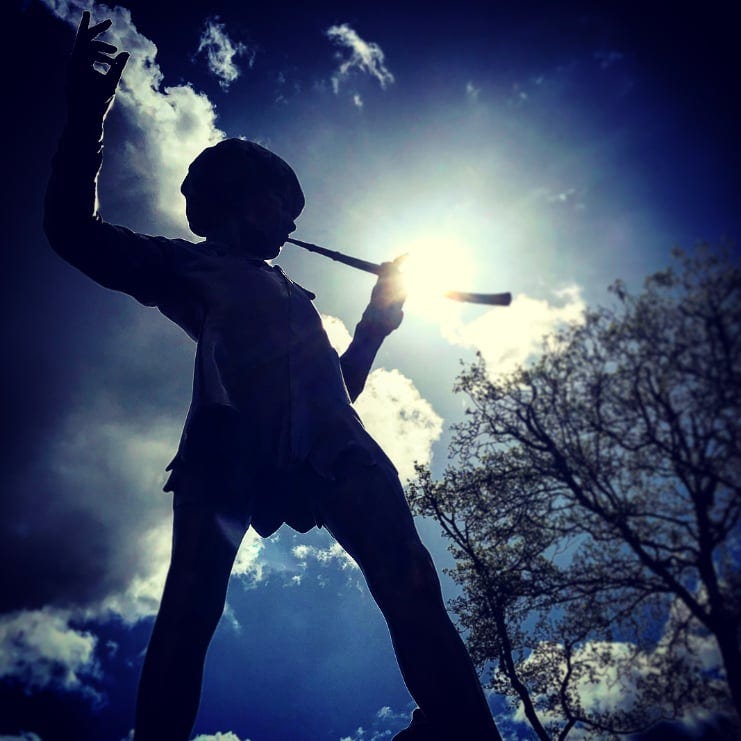
The next morning, May Day 1912, the celebrated author of “Peter Pan”, Sir J.M.Barrie, posted this surprise announcement in The Times:
“There is a surprise in store for the children who go to Kensington Gardens to feed the ducks in the Serpentine this morning … a May-day gift by Mr J M Barrie, a figure of Peter Pan blowing his pipe on the stump of a tree, with fairies and mice and squirrels all around. It is the work of Sir George Frampton and the bronze figure of the boy who would never grow up is delightfully conceived.”
Remarkably, Barrie did not have consent from The Royal Parks to install the sculpture that night. He just went ahead and did it. And the authorities were pretty outraged. Grumbling ensued - but such was the popularity of his gift to the children of London that the statue has remained. Eventually, in 1987, it was granted Grade 1 listed status.
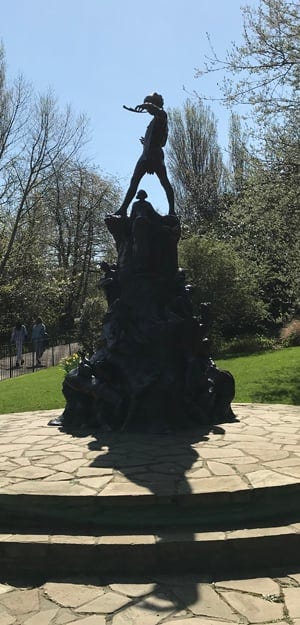
J.M.Barrie lived in Kensington. In his stories Pan first flies from the childrens’ nursery and lands on the bank of the Serpentine - it was this very spot.
And it was this spot, some years earlier, that Barrie had first met the Llewelyn Davies family on his daily walks. They had become friends. He had entertained the three young sons, as they fed the ducks, by inventing stories for George and John: that their baby brother Peter could fly. Those stories were forged on a bench right here.
A few years passed and the family grew to five brothers: “The Lost Boys” perhaps.
Barrie first published the Peter Pan story as “The Little White Bird” in 1902. A stage play followed: “Peter Pan, or The Boy who Wouldn’t Grow Up” in 1904 – featuring Tinkerbell and Captain Hook for the first time. It was all brought together into a compendium children’s edition in 1906 entitled “Peter Pan in Kensington Gardens”.
It was about this time that Barrie, with a sculpture in mind, had asked Michael Llewellyn Davies, the fourth of the five growing brothers, to pose in costume for a series of photographs (Pan’s costume having been established by William Nicholson for the stage production two years earlier). And the idea for the sculpture was born. Sir George Frampton, was engaged for the project. He was supplied the photographs of Michael as a starting point.
Sir George Frampton R.A. 1860-1928 was a leading sculptor of his day – his work includes The Queen Victoria monument in Calcutta, The Edith Cavell Memorial off Trafalgar Square and the pair of huge stone lions at The British Museum. His plaster rendition of the Peter Pan figure made an appearance at the Royal Academy in 1911. The full workings were then passed to the “Parlanti Foundry” for lost-wax bronze casting. Parlanti’s was situated at 59 Parson’s Green Road in Fulham and the work would have been undertaken by Ercole Parlanti in an interim period after his elder brother Alessandro had returned to Italy and prior to his moving the works to Beaumont Street in West Kensington during the war (more info on Parlanti’s Bronze Foundry here).
The statue, to Jamie M. Barrie, was always more than a celebration of his story-telling. To him it was a poignant memorial. There are numerous veiled references in the Peter Pan stories to his elder brother David who had tragically died in childhood. The stories were always in remembrance of the brother he had lost; the statue is a bronze boy who will never grow up.
To this day, theories still emerge as to what happened to David. It is accepted that he died as a result of a collision when ice-skating - a head injury. It has been postulated that there was a bit of a cover-up: that it was actually his brother Jamie that David had collided with, causing a brain injury that, on the day before his 14th Birthday in 1867 had killed him. Either way, the impact on the family and Jamie in particular was profound. Jamie was remembered to have dressed up in his late brothers’ clothes, and mimic his whistling, to help his mother with her grief for, whom the younger brother always felt, had been her favourite son.
The Edwardian public loved their May Day surprise. It is now a celebrated London landmark.
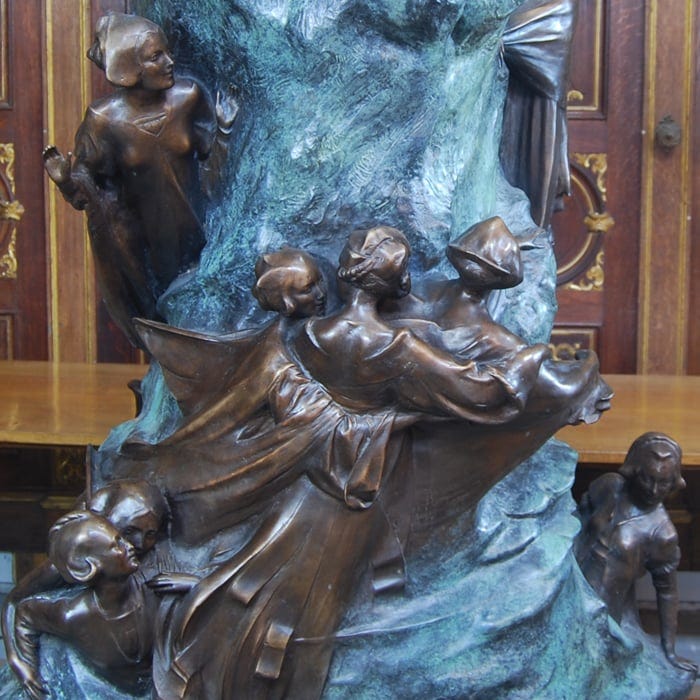
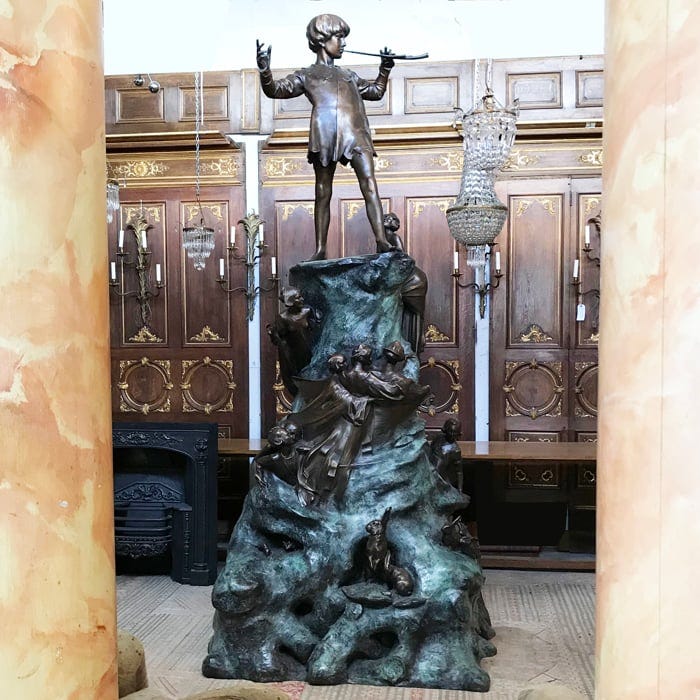
With the origination work done, and the Peter Pan stories meeting worldwide acclaim, a limited edition of the sculptures were cast at the Parlanti foundry. Each was nearly a ton of bronze. These large sculptures - including the base - a spiralling mountain populated with fairies and forest fauna, are now found in prominent public locations around the world: Newfoundland, Perth Australia, New Jersey, Belgium and Liverpool. The original moulds were also used to cast number of the Pan figure alone (without the mountain). Another edition of the full sized sculpture, of another eight, was cast some years later at the Morris Singer Foundry, enabled by The Fine Arts Society. In the two editions only a dozen or so of the full version have ever been cast - the spent mould was destroyed. At LASSCO we were offered, and bought, one of them. Ours was marked “8/8”, the last of the series.
The collection of our purchase, from where it had been stored in a South London warehouse for years, was nerve-wracking. For transportation the statue had to be picked up from vertical with our crane and tipped to the horizontal. We had pre-constructed a timber cradle for Peter Pan to drop into - he just fitted. Back in Oxfordshire we even had to extend the shop in order Pan could be wheeled in. He looked magnificent stood within a panelled room we had just salvaged from Hampshire. He dominated the shop and definitely added a sprinkle of magic (he was found on our website here).
Peter Pan, being Peter Pan, wasn’t with us for long. We were soon approached by a buyer. A deal was done and Peter needed to fly - and in a future post you’ll read the story of who bought Frampton’s sculpture, how much they paid … and how we got him there.
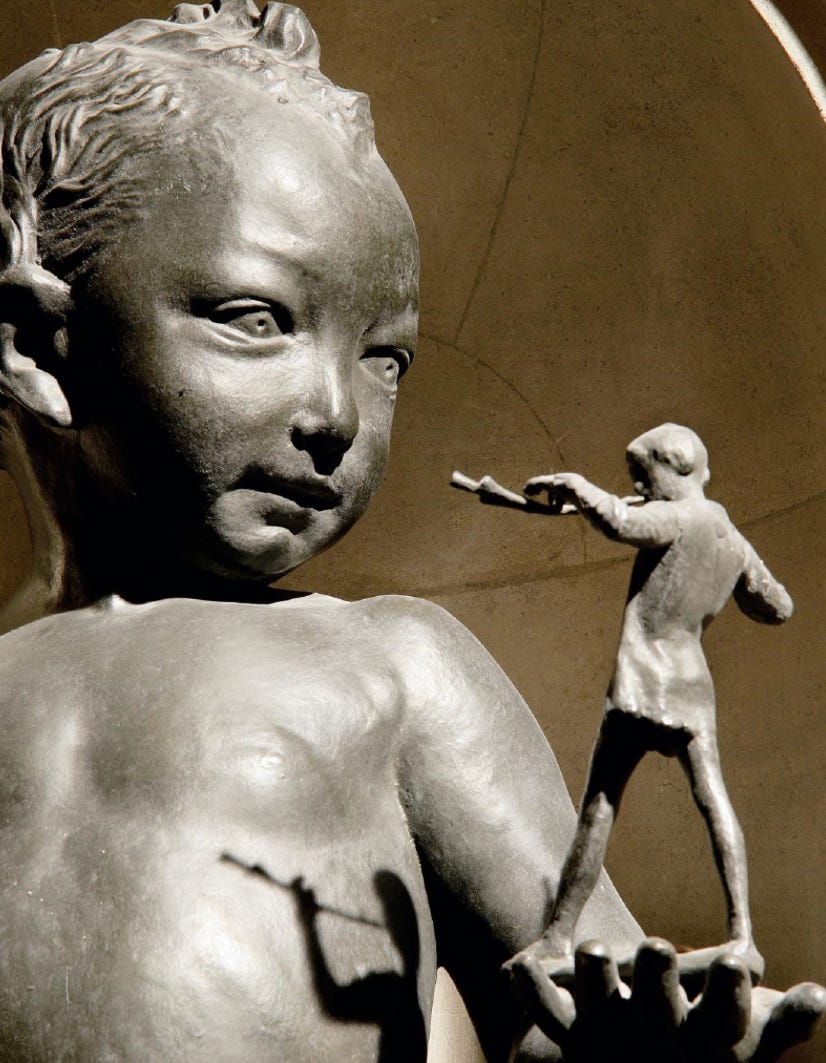
Sir George Frampton R.A is memorialised with a bronze relief in the crypt of St. Paul’s Cathedral. The bronze memorial is modelled as a young child holding a miniature of his treasured Peter Pan figure.
I look forward to reading the next instalment! I hadn’t appreciated that a sculpture was secretly installed as far back as that…… like an early Banksy (in Waterloo Place) or The Secret Handshake (in Washington.)