The Cyrene Paintings
An important collection of paintings - saved from destruction and taken back to Africa - eventually.

“In 1978 LASSCO purchased an extraordinary job-lot at a church clearance auction in East London - two large folios and a large box full of colourful paintings. The paintings, over six hundred of them, proved to be the earliest collected works of the Cyrene Mission - a remote Mission School in Southern Rhodesia, twenty-odd miles south-west of Bulawayo.”
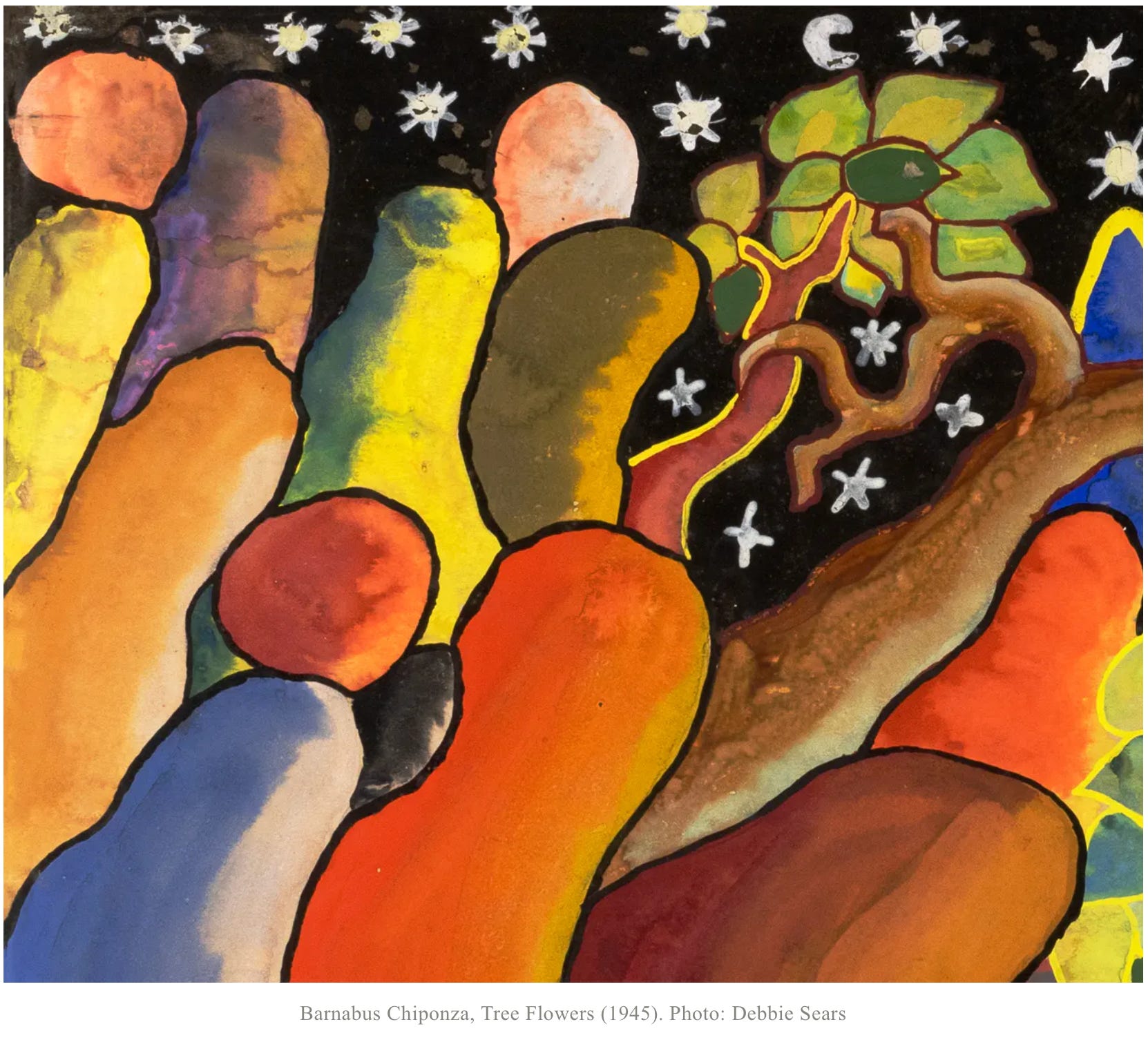
So began the introduction to the entry for the Cyrene Collection on our website in around 2008. The summary we wrote then has since been taken up by academics researching what has since, it seems, become termed the “LASSCO Collection” of Cyrene paintings - long after our sale of them1.
Adrian Amos, the founder of LASSCO, who discovered the folios shoved on a damp shelf in that derelict church took the opportunity to buy them and remembers the scene. The roof of the Clergy House had failed through dilapidation, rain was pouring in. Itinerant tramps of the East End had taken up occupation in various corners of the building. The cavernous nave of the church was also in a poor state; it had been used for years for the storage of excess fittings and fixtures, pews, screens and furniture gathered from other churches in the diocese. An auctioneer was brought in to clear it prior to the sale of the freehold of the gothic complex.
St. Michael’s and All Angels’ Church, The Clergy House and The School House together occupy a block of Shoreditch - a run-down inner-city postcode in those days - between Leonard Street and Luke Street EC2. Adrian bought a number of the other lots, through Duboff the auctioneer, as it was he, together with Geoffrey Westland that were in the process of buying the site. It proved to be a fabulous space in which to put down, display and trade Architectural Salvage for the next thirty years2. Adrian had already been trading salvage from a shop in Hampstead; Geoff had established an Art Handling business running antiques from Germany. The tramps were asked to move-on and the restoration of the fabulous gothic 1865 masterpiece by James Brooks (1825-1901) got underway. This was the birth of LASSCO - The London Architectural Salvage & Supply Company.
Eighteen years later, the Cyrene Collection was still in a cupboard at St. Michael’s, they were cherished but perhaps fell outside of the shop’s main activities in the hectic world of Architectural Salvage. By then LASSCO was doing a roaring trade in Shoreditch and had a second premises just off the City Road in Islington. At that point Hilary Chelminski, at the sales desk in the crammed church, was making valiant efforts to garner interest in the collection in Zimbabwe - and had made good progress (mostly using the fax machine). But the jockeying curators in Harare’s museums, and the death of a key contact tragically killed in a motorcycle crash at a critical juncture of the communications, stymied progress. That is how I remember it when I turned-up for my first day at LASSCO, exactly 30 years ago, in August 1996.
Some framed examples of the collection went off on loan for inclusion in an exhibition “Legacies of Stone: Zimbabwe Past and Present” from November 1997 to April 1998 at the Museum for Central Africa in Tervuren, Belgium; they were illustrated in the catalogue3 .
Meanwhile, I became concerned about the condition of the paintings in the folios. Someone in the past had diligently gone through the large books “re-sellotaping” them in by the corners and damage was evident. 600 acid-free window-mounts were made and we moved to re-mount them all (retaining the original scrapbooks) and cataloguing them - in order to both arrest deterioration and to make a more detailed record. But still with no viable buyer for the collection forthcoming, we put them away again4. The website introduction, that came much later, continues the story and explains the origin of the paintings…
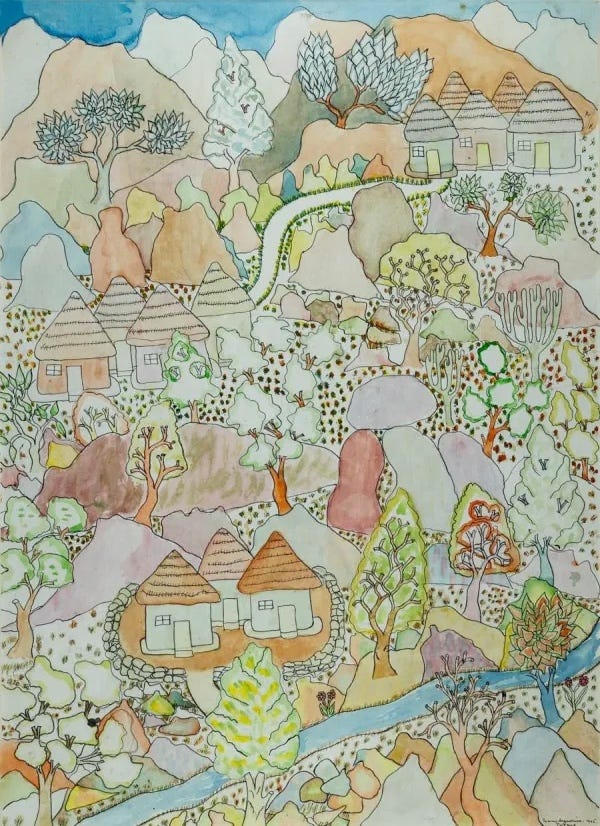
“Cyrene was founded in the late 1930’s by a Scot, Canon Edward (Ned) G. Paterson (1895-1974), who had grown up in South Africa and England before turning to the church and in due course accepting the challenge of creating a new mission school. He was an accomplished watercolourist and took the view that Art should be a compulsory part of the curriculum. He was firmly against imposing Western artistic tradition on students and no reproductions were put up on walls. The boys, generally drawn from Mashonaland’s Bantu tribes with little history of two-dimensional artistic production beyond stone and wooden carvings, textile and costume, were presented with paper, pencil, paint and pen and told to draw the world around them. Some of the results of this output, spanning 1939-45, were stuck into the folios that resurfaced in East London in 1978.
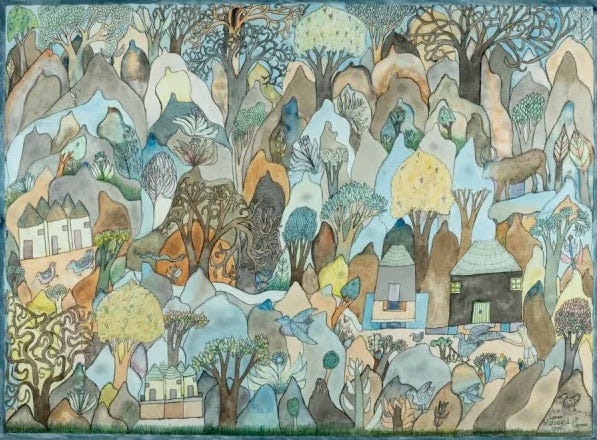
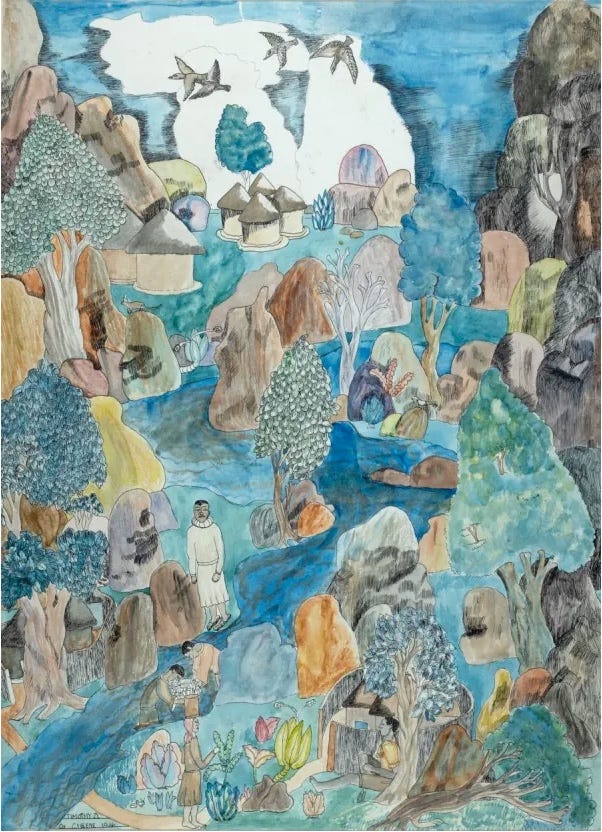
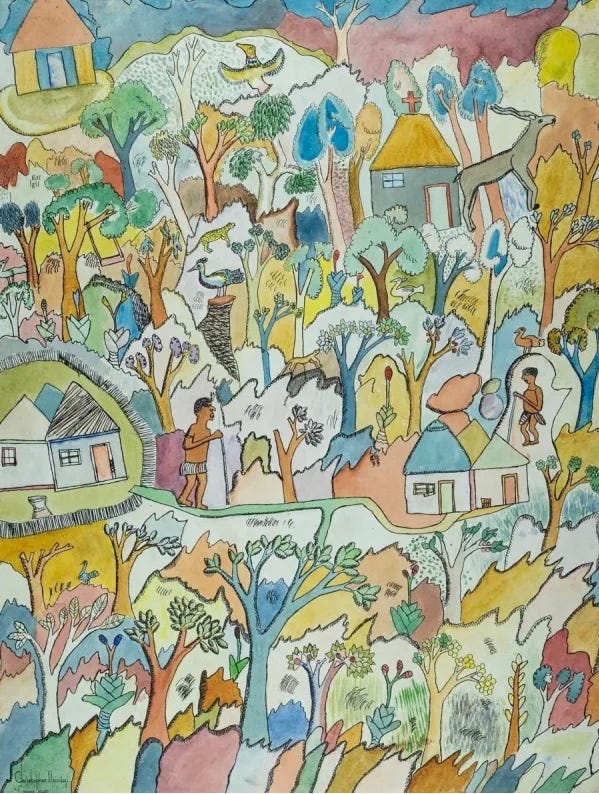
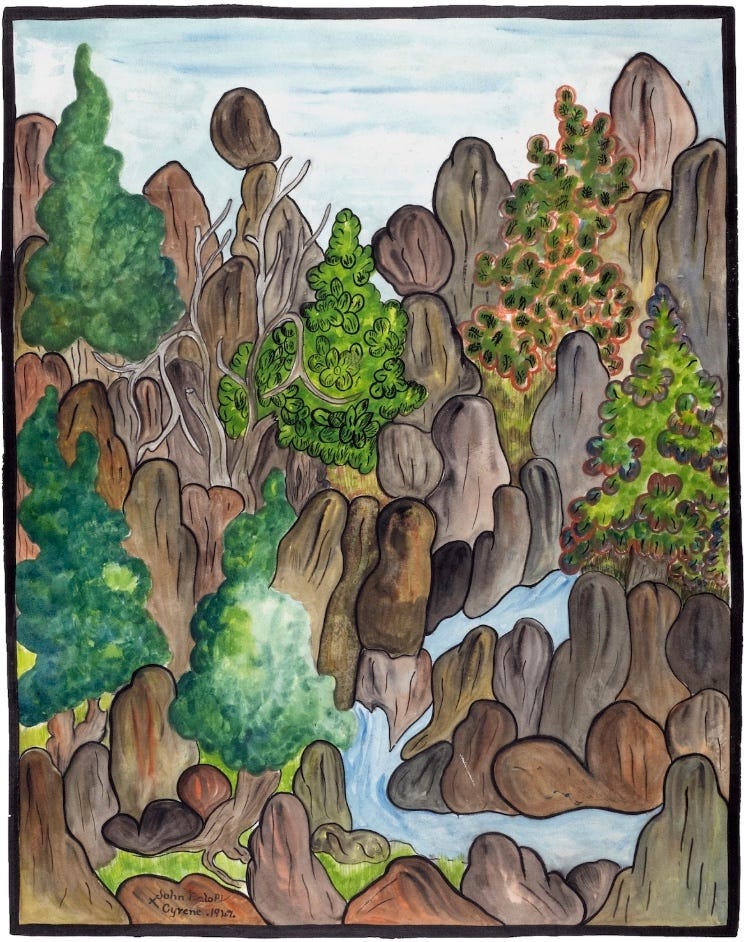
The paintings have a direct association with the landscape and surroundings of Southern Rhodesia. The topography there is punctuated with distinctive rocky outcrops and the young artists have captured the vibrancy of the African colours, the fauna, and even the grumpy Reverend Paterson, with their own style. The discernible style demonstrates a delicate economic line, an obsession for detail (sometimes every leaf of every tree is drawn) and a strong sense of composition. How much of the artists’ technique was nurtured and how much came naturally is of debate - exactly the debate that Paterson was consciously examining at the school.”
Elizabeth Morton in her 2003 paper “Missions and Modern Art in Southern Africa,” describes the wide influence that the stubborn and energetic Reverend had, he…
created a philosophy of art education that was dominant in Rhodesia until the emergence of the stone sculpture movement in Salisbury in the 1960s.5
Morton also notes that,
Although Paterson always claimed that his students produced spontaneous, untainted work, there can be no doubt that his own painting style heavily influenced them.
Terence Ranger in a 2012 paper “Revisiting the LASSCO Cyrene Collection”6 pays attention to the nature of the landscapes that the Cyrene boys depicted:
The Cyrene pupils lived on what was supposed to be a model Christian progressive farm. But their paintings, whether depicting biblical scenes or not, mostly do not reflect Christian progressive agriculture. One painting at least features a plough but many more show hoes. Their cattle do not resemble large imported dairy and beef breeds but the small indigenous cattle of the Matopos. There are no contour ridges, few fields of maize or regular rows of fruit trees. In fact there are hardly any fields at all. The small hutted settlements in these paintings are mainly set among rocks and trees and streams – a Mwali agrarian landscape of wetland cultivation. It is true that some of the paintings – those that depict the Ndebele past, for example – are intentionally historical. But even those which depict an African Christ and his apostles, carrying the message to contemporary Africans, are mostly set in the same Mwali landscape… there is little sense of a glorification of a new landscape over an old one.
…These paintings cannot be appreciated fully unless one knows the Matopos. It is tempting to see their elliptical and brightly coloured rocks as triumphs of abstraction and configuration. But in fact they directly reflect the eroded granite formations of the Matopos itself.7
“With the Cyrene Mission established and Art at the centre of the weekly lessons, Paterson drew wonderful results from his charges.
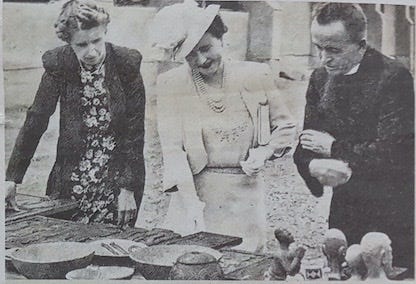
Interest in the Cyrene paintings grew on the back of exhibitions held in Bulawayo from 1944 and then, spurred on by an impromptu royal visit from H.M.Queen Elizabeth to the school in 19478, exhibitions in Cape Town and Pietermaritzburg followed.
Ultimately Paterson himself brought the works to London in 1949 and held an exhibition at the Royal Watercolour Society Gallery in Bond Street. The pictures were met with fascination and acclaim; the show was packed. The collection of Cyrene Art toured England for three years before being shown in Paris and then America. The folios form part of this collection which originally comprised two hundred large watercolour drawings, twelve hundred small drawings and two cases of woodcarving and sculpture.”
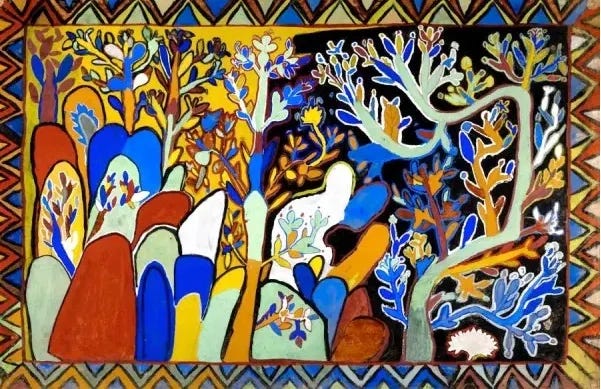
Besides the bearing that Paterson’s own work had on the output of his classes Jonathan Zilberg and Terence Ranger go some way to counter the notion that the Cyrene output could be viewed as the “Ruskinian pure art” Ned Paterson advocated. At the time Paterson was at loggerheads with Frank McEwen, the Director of the National Gallery on such issues. McEwen saw Paterson’s project as religious and insular; Paterson saw that McEwen’s view would taint Southern African art with West African. They sat together on the board of the Gallery and never resolved their differences. Paterson strived to present the Cyrene art as an unfettered response to their world but Zilberg and Ranger point out in hindsight that the boys would not have been oblivious to the spiritual nature and history of the landscape they were painting, even if their irascible tutor chose to wilfully ignore it. Moreover Paterson, whether he acknowledged it or not, was in the grip of a curse:
Cyrene was close to the still functioning cave shrines of the Mwali High God cult. All previous missionaries in or near to the Matopos had been aware of these shrines and some of them had visited them. … The cult enforced its own holy day of rest; distributed doctored seed to ensure fertility; preserved sacred groves; determined what areas could be cultivated, what crops could be grown and when planting could begin. The great rocks of the Matopos and the pools within the caves conveyed powerful symbolic messages. The rocks were all different from each other, giving different messages, and each in itself conveying different meanings according to the direction from which it was approached.
Terence Ranger continues….. “it is hard to think that Cyrene itself was not affected by the power of the cult. If previous missionaries had sometimes visited – and therefore ritually despoiled the Mwali caves9 – Mwali messengers had often visited mission farms. They predicted crippling drought as a punishment for abandoning the precepts of Mwali, neglecting the ordained rest days, and seeking to institute ‘progressive’ agriculture. The huge Catholic farm at Empandeni, south-west of the Matopos, suffered years of drought which its African inhabitants attributed to the anger of Mwali. Cyrene itself was designed to be an important centre for agricultural training but suffered a series of droughts. In 1942, wrote Paterson, they ‘harvested nothing. As the drought continues, day after day, week after week, month after month, one suffers with the slowly dying plant life. In such a time one grasps one’s kinship with nature’. As Paterson’s biographer comments, since ‘the agricultural side of Cyrene proved disappointing, great stress was put on the artistic side’. In that drought year of 1942 Paterson reported that ‘every student draws and paints’. It is hard to believe that some of the African tenants at Cyrene did not see in this drought the wrath of Mwali, directed against ‘progressive’ agriculture.
If the artistic endeavours of the artists at Cyrene were generally focussed on the landscape, not overtly aligned with the aims of the mission - if in other words the paintings did not show the progress of the new Christian community - then it might explain both why a large body of the paintings were ultimately hidden away in London and why Ned Paterson’s involvement in the school was truncated?
Paterson had an unceasing quest to finance the considerable amounts of artistic material his school was churning through. He was inventive with his procurement10 but still had an annual shortfall of £500; The Society for the Propagation of the Gospel (the “SPG”) that backed Paterson at Cyrene and sponsored one of the London exhibitions in 1949, would only put forward £100 p.a. towards these costs.11 Paterson was compelled to raise the rest of the funds himself. He was a master at it. In fact it was the driving force behind the touring exhibitions.
In these exhibitions the SPG presumably wanted to showcase the flourishing of their mission school and the agricultural, religious and cultural advances that came with it. A considerable proportion of artworks of the Cyrene Mission showed the landscape unaffected with these advances, as Ranger identifies, and it was a distinctive landscape, already imbued with its own spiritual meaning to the boys that were depicting it. Zilberg continues…
The mystery question [remains] of: what happened to the Cyrene project in England? Why did these paintings end up in storage? Why was the Cyrene project terminated by the USPG? Did it have anything to do with the Blue Nude oil painting by Kingsley Songo still in storage at USPG in London? No doubt Paterson was considered a loose canon!12
These nebulous ponderings might help to explain why the collection was abandoned and perhaps why Paterson left the school he had founded in 1953, but we may never know for sure. However, in terms of African boys recording their home terrain in a fresh and vibrant way, notwithstanding the Anglicans sponsoring them, the pictures can be considered all the more poignant.
The story continues…
“We know that Paterson was actively selling some of the works as they toured so some were dispersed but, of the original collection, later folios dating to around 1945 have been acquired by The Bodleian Library in Oxford UK and by The Smithsonian Institute in Washington. A scrapbook of a further 200 paintings dating to the early 1950’s is held at the library at Central St. Martin’s School of Art in London. Paterson had studied there in the 1920’s. Between these collections and the LASSCO folios, which comprise the earliest works from 1939 when the mission was founded, it must be assumed that the main body of the original collection is accounted for - the rest dispersed.13
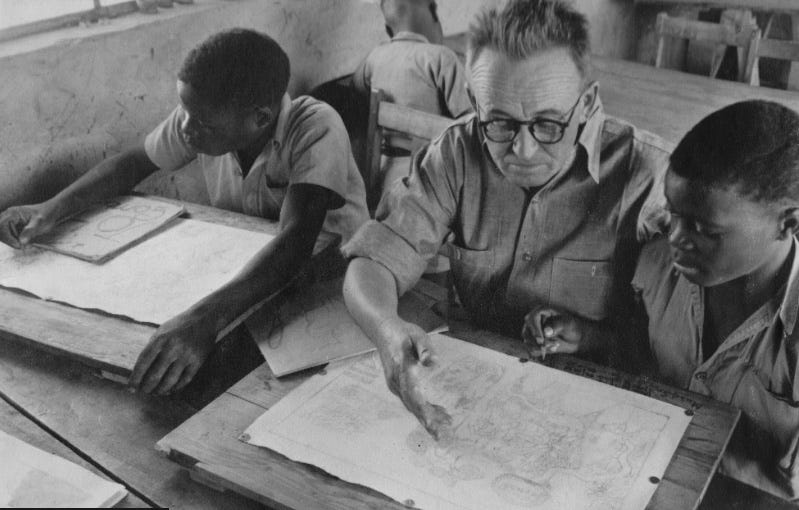
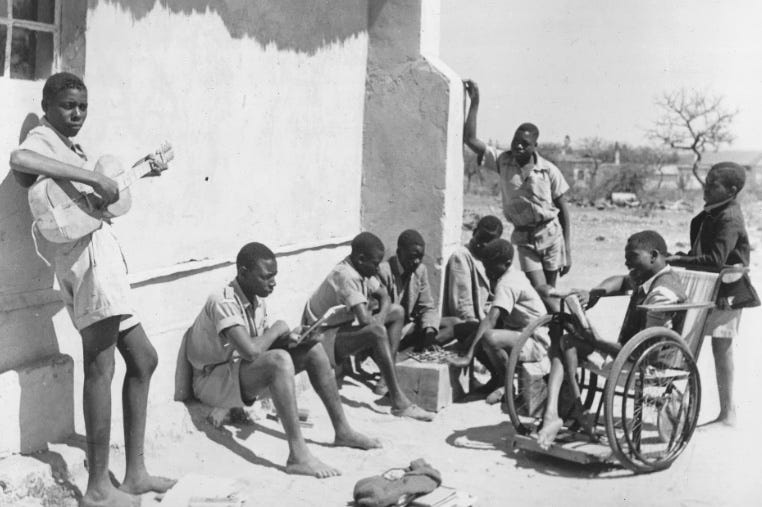
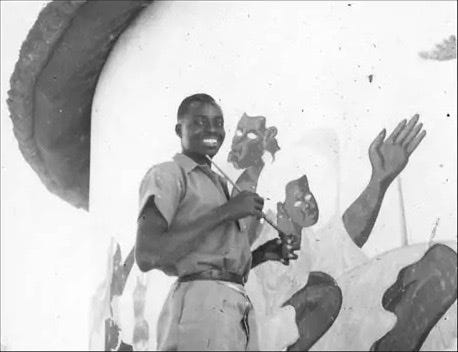
Paterson evidently observed the boys’ progress carefully. He had them decorate the walls of the Mission Chapel with extraordinary murals of Biblical scenes with African themes - it was an honour to be selected as a muralist and add to the work that Paterson had started. The chapel still stands, the murals having survived a fire in 196214. Some of the boys went on to become noted artists in Bulawayo, Harare and beyond. Disabled boys at the school were permitted to spend more time in art lessons and some of their works are particularly accomplished and are found within the collection. At its outset there was no age restriction for education at the Mission; the boys were in their teens or early twenties. Their work is generally signed in what we take to be Paterson’s hand.15
Paterson left Cyrene in 1953 for a stay in England before returning to Harare (then called Salisbury) to build up two successive Art Centres there. He died in 1974. The school moved to Bulawayo in 1978 during the Liberation War and the property was taken over as “Fort Godwin” by the Rhodesian army. More recently the property has been a boarding school. The adorned chapel was declared a national monument in 1987 and is still used for active worship.”
And our summary concluded:
“LASSCO hopes to keep this collection together and find a buyer who will preserve this poignant record of young Africans and their unfettered response to the world around them in mid-20th Century Rhodesia”.
These hopes were ultimately realised. But it took decades.
On one occasion, around 2003, I had connected with an elusive Rhodesian who lived in a fabulous Hampstead home with a spectacular view. He had the funds to buy the collection and was interested when I turned up with a representative stack of the paintings for him to consider. But I failed to encourage him that sunny morning as we talked, looking across the London landscape spread-out beneath us. I returned to St. Michael’s without a deal.
We still had the stacks of re-mounted paintings in the bookcases of the back-office of St. Michael’s in the winter of 2006 when finally LASSCO St. Michael’s had taken the monumental decision to relocate to Oxfordshire. In our new shop, “LASSCO Three Pigeons”, we unpacked the collection and displayed them in a couple of very large museum cases. And we told their story in the cabinets and on the website. We were looking for someone with whom they would make a connection and fire enthusiasm; someone who would preserve them as a collection and pass on the legacy.
At last we found those people in Anne and Garry Charnock who were thrilled to buy the collection. I duly delivered the paintings to them in Cheshire and passed on everything we knew. Anne and Garry in their days as foreign corespondents in Africa and as campaigners for a sustainable world, and as authors, had exactly the right skill-set to take the Cyrene collection forward16. They did more research and moved to stage an exhibition in The Guildhall in the City of London. Ultimately the elusive Rhodesian stepped in: he bought the Cyrene collection and placed it in the hands of The Belvedere Trust (or more recently “The Curtain Trust”).
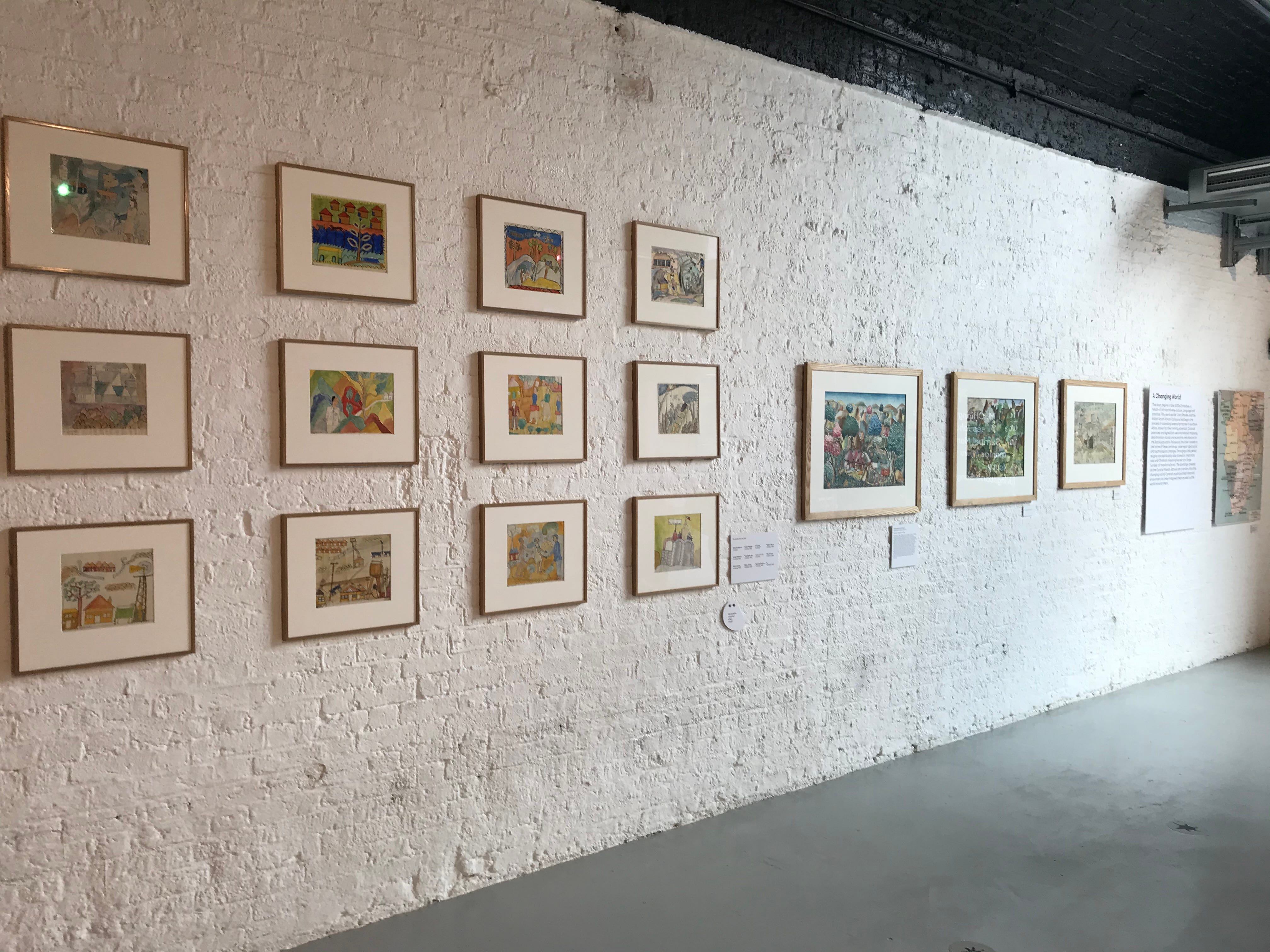
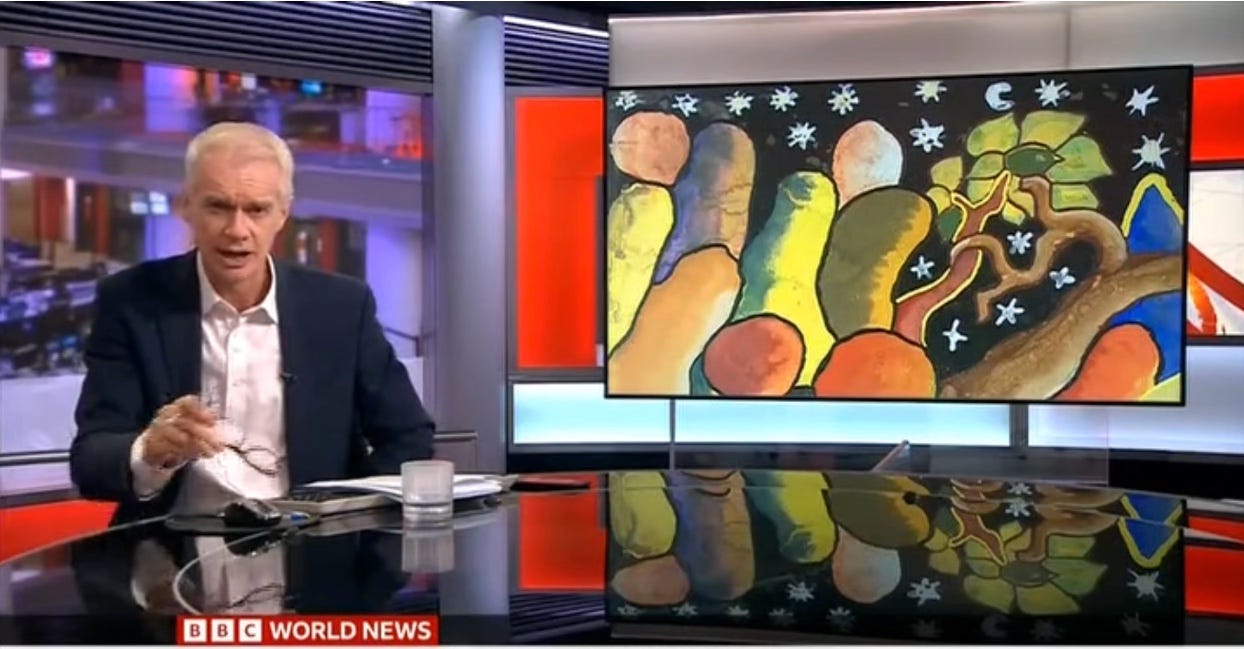
The Cyrene paintings were to find their way back to Shoreditch in 2020, as London emerged from the Covid19 lockdown, to be shown in a dedicated exhibition titled “The Stars are Bright” in The Theatre Courtyard Green Rooms. We were invited. It was a splendid show. In the staging of the exhibition admirable efforts had been made to shift the focus from Ned Paterson and the Mission towards the individual artists themselves. Paterson, with fundraising always in mind, had tended to promote the art as a collective endeavour - the more accomplished artists such as Samuel Songo, Kingsley Sambo and Timothy Dhlodhlo did receive some credit and recompense, others such as Basil Mazibuko, Christopher and Mhletshwa Msidazi, and Simon Hlabate, with school fees to pay, often received little or no rumuneration for their work. The trust sought to address this by focussing on the artists.
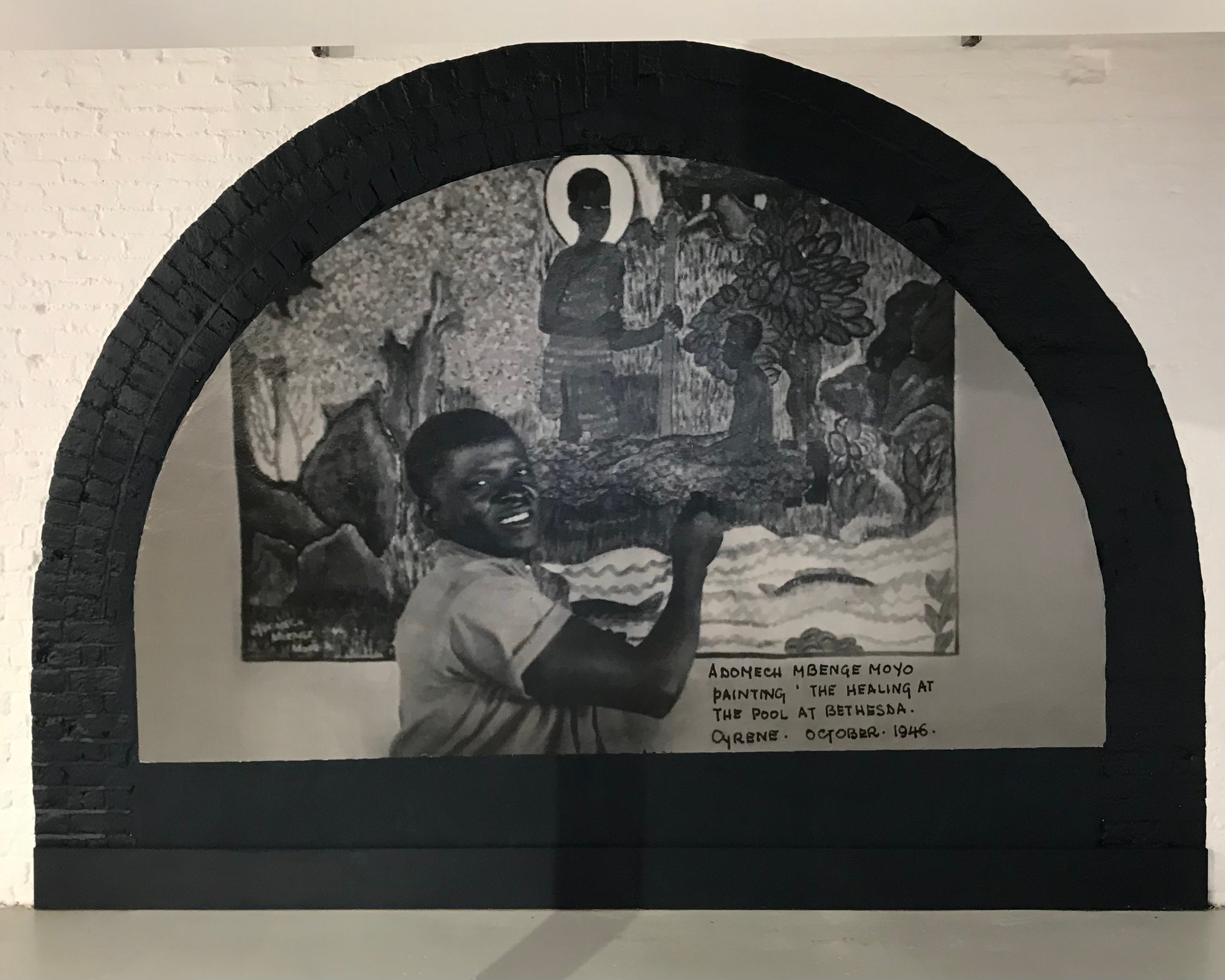
In time, the show moved on, and the Exhibition triumphantly reached Zimbabwe in the National Gallery in Bulawayo in 2022, where a bus-load of today’s Cyrene pupils came to see it. The tour culminated at The National Gallery of Zimbabwe in Harare - where the President of Zimbabwe was in attendance. The return of the paintings to Zimbabwe was met with jubilation and glee. There have been many voices calling for the collection to be permanently retained, restituted to Zimbabwe (but such voices were silent in the years that we were looking to achieve that on the fax machine)17.
Jonathan Zilberg gets the final word:
In my imagination one great unrealized value then of the LASSCO Collection is that it will generate future research and awareness of this colonial era art history. And ultimately the significance of all this to me is that the Cyrene paintings and the larger Cyrene story show us how modern art in Africa is in fact as much connected, rather than disconnected, both to local history as to traditions adapted and implanted from afar. At the end of the day, these paintings evoke the unique nature of the Matopos landscape and its social history, perhaps even a Mwali view as Terence Ranger describes it, but they also reveal so much more – creative joyful moments in the lives of young students in colonial Rhodesia during World War Two…
Are we not glad then to be able to stand before the Cyrene paintings no longer in the dark gathering dust in an abandoned church in Shoreditch but shining in the light?18
References
African Music Society “Cyrene Exhibition in London: Extracts from the Press”, African Music Society Newsletter, 1949 1(2): March 28-30.
Anon “Cyrene School of Art”, African Music Society Newsletter, 1948 1(1) June 23-24.
Anon “Wonderstone Wonders. Sculpture of Samuel Songo” Time, 1954, August: p. 58.
Anon “Unique African Religious Paintings” Rhodesia Calls, 1973 Vol. 80, July/Aug pp. 19-25.
Cyrene Mission, Visitor’s Guide, 1994 Bulawayo: Cyrene Mission.
Devlieger, P, “Representation of Physical Disability in Colonial Zimbabwe: The Cyrene mission and Pitaniko, the Film of Cyrene”, Disability and Society (1998) 13 (5):709-724.
Ehrenzweig, A. “The “African Schoolboy” Art of Cyrene”. The Studio, 1954, 148 (738): pp. 80-83.
Fosu K “20thC Cyrene Centre: Benson Dube” Century Art of Africa, 1986, pp. 49-50. Zaria: Gaskiya.
Jones, W. F. Frangon. “Religious Patronage: Cyrene”, 1958, Cape Town.
Kowo, Kudzai “Cyrene Art: 50 Years Back”, The Artist, April 1990.
Lombard, S, “Cyrene”, Jeune Afrique, 1951, 5(15): pp. 4-8.
Morton, E. Gron, “Ned Paterson and the Cyrene Mission Tradition”, in “Missions and Modern Art in Southern Africa”, 2003, pp. 68-110. Ann Arbor: UMI Dissertation Services.
Paterson, E, Canon, “The Nature of Bantu Art and Some Suggestions for its Encouragement”, Nada, 1942, 19 pp. 14-15.
Paterson, E, Canon, “Cyrene: Africans in the Making”, 1949, Westminster: The Society for the Propagation of the Gospel in Foreign Parts.
Randles, E, “Mission Art in Zimbabwe”, in “Legacies of Stone: Zimbabwe Past and Present” ed. G.Bourgois, vol 2, pp. 71-83, 192. Tervuren: Royal Museum of Central Africa.
Rankin E and Miles, E, “The role of the missions in art education in South Africa”, Africa Insight, 1992, 22(1), pp. 34-48.
Vera Yvonne, “Two Schools in Zimbabwe”, in “Anthology of African Art: The Twentieth Century” ed. F N’gone, New York, Distributed Art Publishers.
Walker, D.A.C, “Paterson of Cyrene”, 1985, Gweru: Mambo Press.
Wall, B, “Paterson of Cyrene”, Arts Zimbabwe, 1981, vol2, pp. 27-38.
Ranger, T.O, “Making Zimbabwean Landscapes: Painters, Projectors and Priests”. Paideuma (1997) 43, pp. 59-73.
Zilberg, J. “Zimbabwean Stone Sculpture and the British Arts and Crafts Movement: An Experiment in the Spirit of Ruskin and Morris” in Zimbabwean Stone Sculpture: The Invention of a Shona Tradition”, 1996, pp26-79. Ann Arbor. UMI Dissertation Services.
Anthony Reeve: in “Religion and Landscape at Cyrene Mission”, comprising Part I of “Revisiting the LASSCO Cyrene Collection” by Jonathan Zilberg Ph.D, 2012, Center for African Studies, University of Illinois at Urbana-Champaign
The history of St. Michael & All Angel’s Church is expanded upon here: https://www.lassco.co.uk/lassco-news/2015/01/19/st-michael-and-all-angels-church-shoreditch-lasscos-home-1979-2007/
“Legacies of Stone: Zimbabwe Past and Present” November 1997 to April 1998, Museum for Central Africa in Tervuren, Belgium, illustrated in the catalogue (pp.165-168)
Those calling for the restitution of the Cyrene Collection to Zimbabwe may note the continuous and strenuous efforts made to find a proper home for this important collection over decades!
Elizabeth Morton “Missions and Modern Art in Southern Africa,” 2003, Emory University, Chapter 2: Ned Paterson and the Cyrene Mission Tradition
Terence Ranger: in “Religion and Landscape at Cyrene Mission”, comprising Part 2 of “Revisiting the LASSCO Cyrene Collection” by Jonathan Zilberg Ph.D, 2012, Center for African Studies, University of Illinois at Urbana-Champaign
Ranger: Ibid
Queen Elizabeth, later “The Queen Mother”, brought considerable attention to the Cyrene mission and was to buy works when at the school, where TV cameras recorded her unscheduled visit, together with King George VI and the Princesses Elizabeth and Margaret, and later at the London exhibitions - works that are still in the Royal Collection today.
Not to mention Cecil Rhodes who is buried atop one of the Matopos peaks(!)
Morton, Ibid: “….he dreamed of resurrecting the soapstone carving found at the Great Zimbabwe archaeological site. For years he listened for news of a soapstone deposit, though he resorted to obtaining several tons of wonderstone for his students in the early 1940s”. (FN: “The wonderstone was part of a huge cache sent to southern Africa by the British government to be used for war grave headstones”).
Morton, Ibid.
See Morton, Ibid. p.90 for a summary of Songo’s life and works.
Ranger, Ibid. also cites folders of Cyrene work, as well as folios from “Chirodzo”, Paterson’s later art school in Harare, having been donated to the national Archives in Harare via the director of the Archives, Paterson’s great friend, Hiller.
It was in fact an arson attack by Nationalists.
It’s thought some, marked with an “F”, may have been by girls attending art lessons at Cyrene.
Instrumental in the Cyrene story, Anne Charnock DLitt, a celebrated author, has a new novel out in September 2026 “Alston Moor”.
The collection re-appeared on show in the Zimbabwe Embassy in London last year [2025].
Conclusion to “What is Cyrene Art? Why is it so important?” Part III of “Revisiting the LASSCO Cyrene Collection” by Jonathan Zilberg Ph.D, 2012, Center for African Studies, University of Illinois at Urbana-Champaign
Love these paintings and your story of their story.