The Philosophers
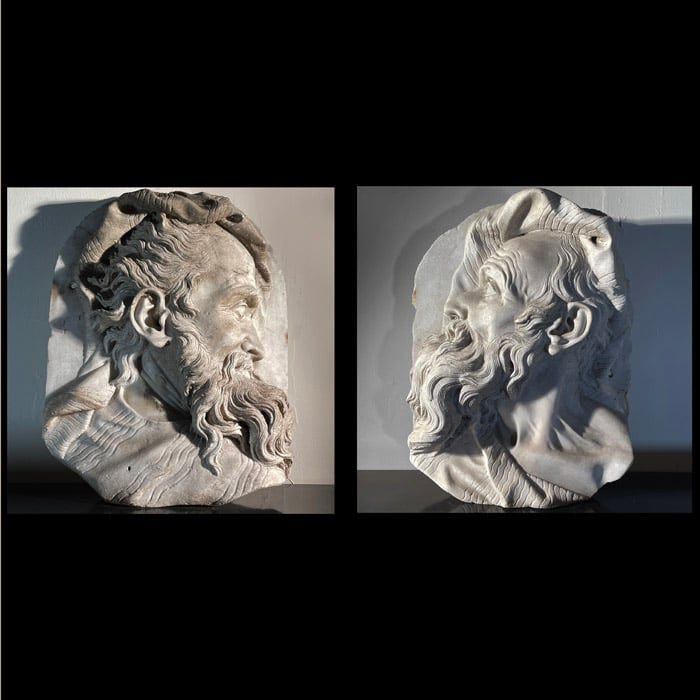
You just never know what you might find: a pair of beautifully carved early 18th Century Venetian marble portrait plaques sitting in a plastic crate in a Hampshire garden.

It all started on a beautiful sunny day in a conservatory, in a cul-de-sac, in the New Forest, Hampshire. I was there to look through, and buy, some very interesting stained glass “hangers” – small round and diamond sections of leaded stained-glass stacked in a box, wrapped in old newspaper. Some of the leaded glass fragments were Victorian, some seemed to have a connection with Oxford, but others were early; medieval stained glass is very rare. A deal was done, and a cup of coffee was had, before I headed-off to the next port-of-call, in Dorset.
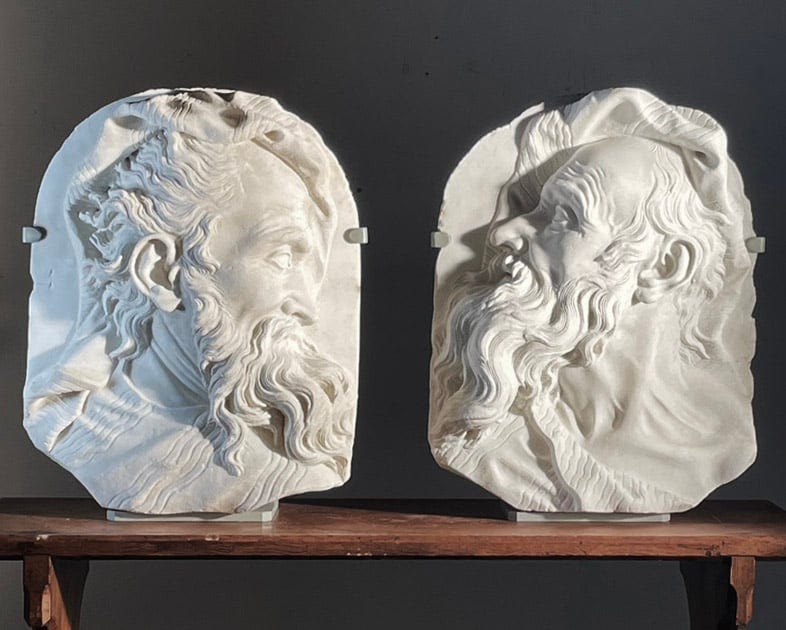
Before leaving though, as an after-thought, there were a couple of pots and other bits to have a look at, just outside the conservatory. And by the fence, was a green plastic box and in it were two carved marble plaques. Each plaque was carved in relief with the profile of a bearded man – and they were beautifully carved too. The back of each plaque had a rusty old wrought-iron peg sticking out. They were slightly green with algae having been sat outside in the plastic crate for some time.
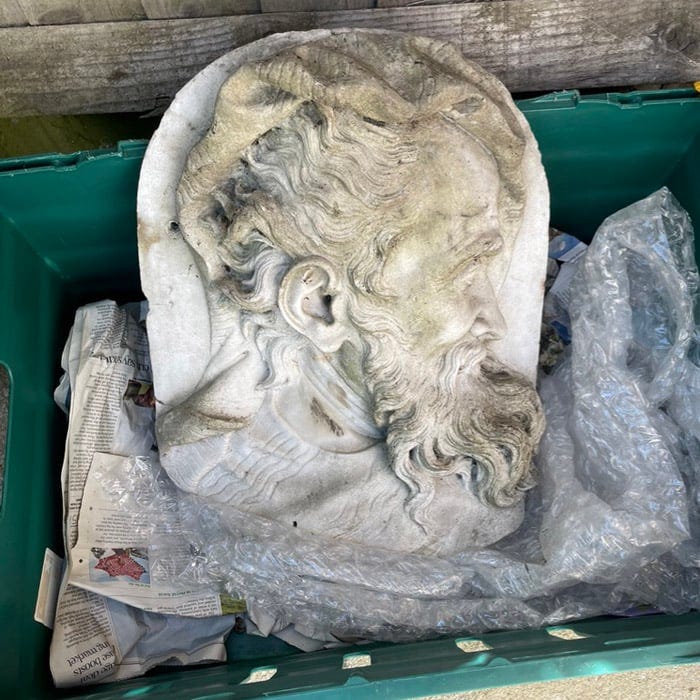
The vendor had said that they, the stained glass and the marble plaques, had belonged to their late grandfather – he had been an antiques dealer. But, no one in the family wanted these things and the time had come to sell them. After the stained glass deal I was a bit spent-out (it had all added up) but an additional deal was done, the bearded men plaques were added to the haul, and off I went.
Back at the shop, I put the plaques on the shelf of the fireplace in the office. Looking at them more closely Tom and I started to revise our opinion of them upwards - they weren’t just good - they were something really rather special.
We started to look into the history of such plaques - looking for comparable examples. We very carefully cleaned the marble. We had a museum display-stand company make some stands so the plaques can either be wall-mounted or securely stood upright (we left the rusty peg in the back of each but treated them in order to stabilise the corrosion). The more we looked at the wonderful carving and the more we looked for comparisons, the better it started to get. And the more we looked into the grandfather of the vendor - the antiques dealer called Murray Adams-Acton - the more intriguing that became too.
He, it transpires, was one of the most successful dealers in medieval and early English furniture of his day. Together with his business partner Frank Surgey he salvaged and bought extraordinary things and sold them to the burgeoning American museums and elite private buyers found between-the-wars in London. As it was Murray Adams-Acton who had owned the plaques, we were compelled to dig deeper into the history of who might have carved them, and when.
We honed it down to a short-list of likely sculptors: our list of possibles were ambitious. We couldn’t take it further though. To get a correct and firm attribution we were going to have get an expert opinion. The sculpture department at the Victoria & Albert Museum recommended we read some academic papers that expanded on the sculptors we were focussing on, but they weren’t able to help further.
Simone Guerriero was the author of the majority of those papers. He is an Art Historian in Venice, specialising in the sculpture of the Veneto from the 17th to the 19th Century. He had been involved in exhibitions of such works and is widely published on the subject. One of the academic portals that enabled us to read his articles offered a profile page of the respective academic. And there was a button to “Contact the Author”. So I pressed it.
I explained that we were stuck with our research.
Simone responded straight away: he knew exactly who the plaques were by. We exchanged further emails and commissioned him to produce a report - he was happy to firmly attribute the bearded men to one of the sculptors on our list.
The report arrived a few weeks later and it was very good news.
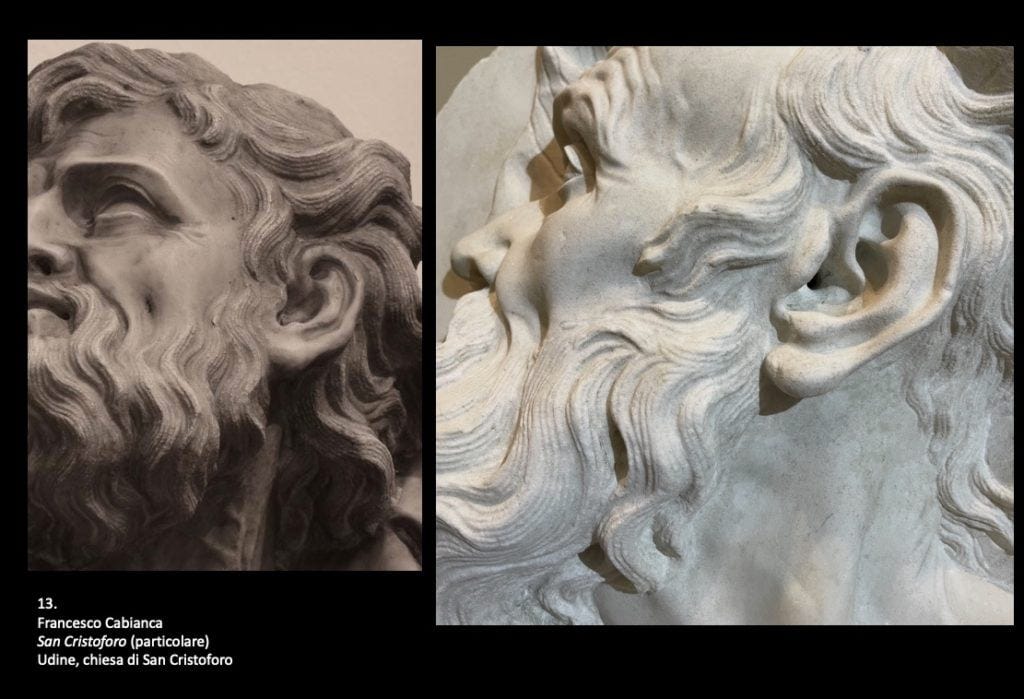
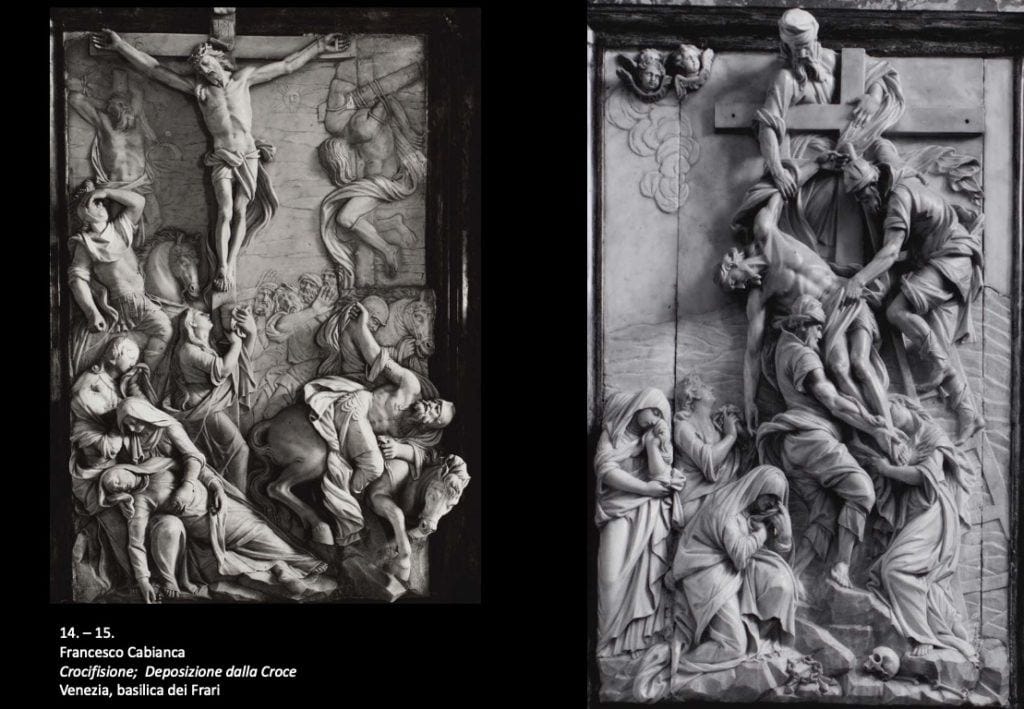
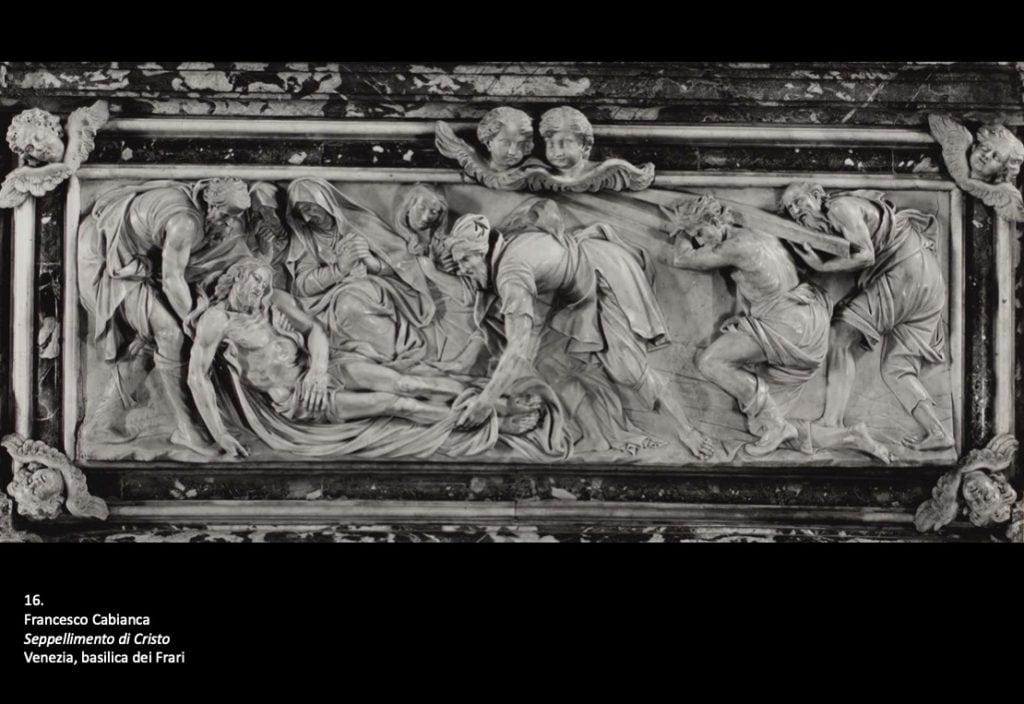
It was wonderful to see how he arrived at his attribution, the tell-tale details and marks and influences and styles enabled Simone to put our sculptures alongside other works for direct comparison. He demonstrated exactly whose hand, with a “snappy and nervous character” chiseled out these plaques over 300 years ago. He firmly attributed them to the Venetian sculptor Francesco Penso, known as Cabianca, (1666-1737).
The plaques themselves most likely dated to around 1710 shortly after Cabianca had returned to Venice after 10years in Dalmatia (Dubrovnik) - he had left Venice on the advice of doctors as he was suffering from venereal disease. His return was to result in some of his best work.
Simone explained what the image of the Philosophers – for that is who they are – meant to Venetians of the time and how it was a canon, a cult almost, which a number of Cabianca’s contemporary sculptors also explored. Pairs of Philosophers “populated art collections in Venice at the turn of the seventeenth and eighteenth centuries”…
“Usually, as here”, Simone continued, “these figures do not show specific iconographic attributes that would indicate a precise identity in the roster of ancient thinkers: more generically, their features often reveal a stern, pensive attitude and they are almost always bearded elders, displaying an intense but detached gaze.” ….
The images of philosophers, represent introspective thinking aimed at understanding what humanly matters (love, friendship, knowledge), they invite us to recognise the vain and frivolous nature of many aspects of worldly existence and be reminded of the fragility of life, the transience of earthly things. It is Philosophy as an antidote to Vanitas.
Beginning in the 17th century, depictions of ancient thinkers became the object of particular interest throughout Europe, on the part of patrons and collectors, and thus an almost constant presence within collections.
Simone went on to detail much of Francesco Cabianca’s career and pointed us to his work which can still be found today – in Venetian churches, Colleges, the Venice Arsenal and, after a series of busts he executed for Tsar Peter the Great, in Pavlovsk Palace near St. Petersburg. [Regular readers of Architectural Salvage Journal will remember Pavlovsk detailed in a recent post concerning some Russian Bronzes we bought].
Cabianca’s work is indeed often breathtaking – one cited commentary (by Camillo Semezato in 1966) opines about one of his carved marble reliefs that: you will not find “so much rhythmic continuity in any other Venetian sculpture of this period [with] so much skill in composition”. And Simone Guerriero himself concluded his report that “Cabianca was therefore certainly one of the greatest protagonists in the panorama of Venetian sculpture in the decades at the turn of the seventeenth and eighteenth centuries”.
I put down the report. Whilst I had come to suspect that the carved plaques left in the green plastic crate in the garden in Hampshire were good, I wasn’t quite expecting them to be that good. The Philosophers, now cleaned and spot-lit mounted in their smart cradles above my desk quietly looked on. Their secret was out.
I wondered again about Murray Adams-Acton and how he had come by them, and why he had kept them and not sold them. I did some more digging.
Acton Surgey - Dealers Extraordinaire
Murray Adams-Acton (1886-1971) is remembered as a flamboyant character who had a notable career in the world of interior design and antiques, mixing in the highest echelons of London society. He, it transpires, was an Architectural Salvager beyond compare.
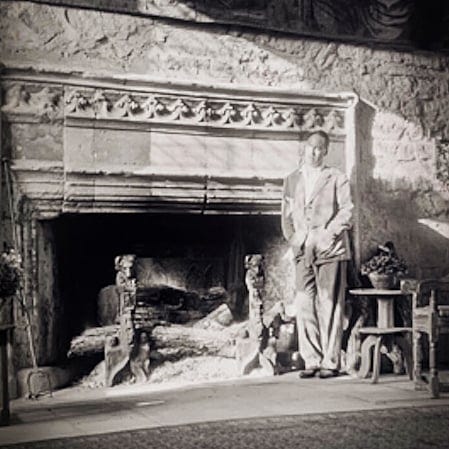
Adams-Acton’s early working life, in Edwardian London, was at White Allom Ltd – Sir Charles Allom’s (1865-1947) design firm that was running prestigious interior decoration and design projects on both sides of the Atlantic. They worked for notable clients – including for the Frick family, with the creation of the Frick Museum, and for the Crown with the new extension to Buckingham Palace. It was at White Allom that Adams-Acton first fell-in with Frank Surgey (1893-1974) who worked at both the London and New York offices as assistant to Sir Charles. Adams-Acton’s drawings and designs from this time were exhibited at the Royal Academy in London between 1909 and 1915.
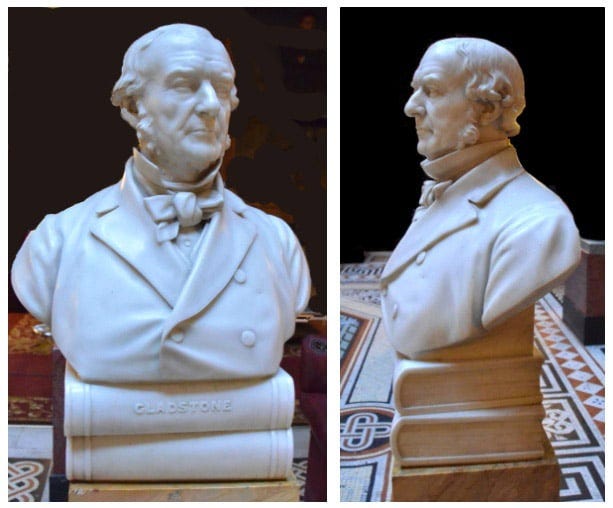
Murray’s father, John Adams-Acton (1830-1910), was a talented sculptor. His portraiture in marble was held in high regard. Having won the Royal Academy’s Gold Medal for sculpture in 1858 he had spent some years in Rome, on the resultant travelling scholarship, studying under John Gibson. He thereafter submitted numerous busts and statues to the Royal Academy shows, as well as for public commissions, both in England and the Empire. William Gladstone sat for the sculptor on at least two occasions and they became great friends; Gladstone was to be Murray Adams-Acton’s godfather (his full name was in fact Gladstone Murray Adams-Acton). Other sitters included, Benjamin Disraeli, Charles Dickens and Pope Leo XIII. In 1910, John Adams-Acton sadly died from injuries sustained in a motor-car accident – an early victim of a new and growing phenomenon.
The house where Murray grew up in St. John’s Wood – he was the fourth of five children – was known for social gatherings of all the mover-shakers of the day. His Scottish mother Marion, daughter of the 11thEarl of Hamilton, was a successful author of children’s books under the name Jeanie Hering and her parties, it seems, provided a social hub to those in the artistic circles of Edwardian London.
When war broke out in 1914 Murray, by then aged 29, joined up with the Scots Guards and during his service was to rise through the officer-ranks to Colonel. His former White Allom colleague Frank Surgey, meanwhile, had joined the Air Flying Corps and spent the war years heroically engaging in aerial dog-fights over Flanders, surviving a number of crash landings.
After the war, Adams-Acton and Surgey joined forces and formed “Acton Surgey”: dealers and consultants specialising in medieval art, sculpture, old English furniture and Architectural Salvage. For years, Adams-Acton wrote numerous articles on decoration and old furniture for ‘Apollo’ and other magazines such as ‘The Connoisseur’, publications that Acton Surgey were to regularly advertise in. He became a Member of the Architectural Committee of the Royal Academy, and a Member of the Society for the Protection of Ancient Cottages. He wrote ‘Domestic Architecture & Old Furniture’[i] demonstrating his expertise on the subject; his particular speciality was to become old English linenfold panelling [ii], and the company regularly dealt in the selling of entire salvaged rooms. Their stock, initially, was showcased at their gallery at 1 Amberley Road in Paddington, as well as a premises in Crews Hill, Sussex.
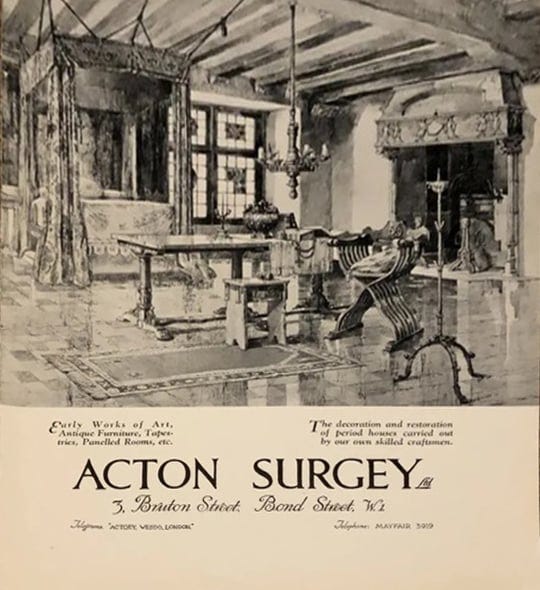
In “Moving Rooms – the Trade in Architectural Salvages” John Harris keeps pace with the sales that Acton Surgey were involved with at a time “…when American museums were thirsting for English rooms”. They offered the “Hayes Grange” room extracted from Sir Edmund Davis’ house in Lansdowne Road to the V&A in 1926 [iii]. They offered the Great High Chamber from Gilling Castle, Yorkshire to Philadelphia Museum of Art in 1929 [iv] and oak panelling, dated 1529, thought to have been from Red Lodge, West Wickham, Kent [v]. In the same year they handled the sale of Robert Adam’s Drawing Room from Lansdowne House on Berkeley Square to The Metropolitan Museum of Art in Washington DC, selling it for $10,904, and the Dining Room which went to Philadelphia in 1933 [vi]. They bought a George II interior from St Margaret’s Place in King’s Lynn and sold it to the new Nelson Atkins Museum of Art in Kansas City in 1931. And Robert Adam’s “palm tree tea pavilion interior” from Moor Park Hertfordshire – sold in 1933 to a private buyer to install in a house thought to be in Virginia or Maryland.[vii]
By 1930 the shop was at 3 Bruton Street, off Bond Street. Clients could also see stock displayed at Weycroft Abbey, near Axminster, Devon. Two of those clients in particular were to dominate much of their later careers: Sir William Burrell (1861-1958), the wealthy Glaswegian shipping merchant and art collector, and the publisher William Randolph Hearst (1863-1951), the most voracious buyer of Architectural Salvage the world has ever known.
Sir William Burrell had bought Hutton Castle, Berwickshire in 1916 and having had it extended after the war, finally moved-in in 1927. Acton Surgey were engaged by Burrell to furnish the castle – a project that was to last for seven years – their final invoice was for £58,000.
The Acton Surgey visitors’ book from this era is extraordinary – Adams-Acton’s grandchildren in Hampshire still have it. On one page alone it is signed by Constance Burrell, William Burrell, Duke of Rutland (of Haddon Hall), C.Reginald Grundy (the editor of The Connoisseur), William Randolph Hearst and Sir Joseph Duveen. On another page there are two signatures alone – “Mary R, 8th July 1932” and “Victoria Forester”; Queen Mary (accompanied by her Lady-in-waiting) was an expert in ceramics and early furniture.
The two dealers are usually described as flamboyant, Adams-Acton as a “flamboyant extrovert”. They were accomplished yachtsmen, a habit no doubt learned from Charles Allom and his racing yacht “Istria”[viii]. Frank Surgey was reputedly a remarkable shot too and, with his own Holland & Holland’s, had attended shoots alongside King George V on a few occasions (as well as racing against his royal highness in the Solent in Allom’s “White Heather”, the king aboard “Britannia”).
When war broke out again, Adams-Acton returned to his old regiment in Inverness, only to later receive the news that his shop in Bruton Street had been completely flattened in the Blitz. He recalled that ‘nothing was left, documents, tapestries etc., went up in smoke’[ix]. Surgey meanwhile moved to Blackburn in Lancashire and ran a factory making aeroplane parts for the Ministry.
Before the war Acton Surgey had been supplying William Randolph Hearst as he exuberantly kitted-out St Donat’s Castle with Architectural Salvage from across the UK and Europe; the work was overseen by Sir Charles Allom, Murray and Frank’s former boss. On Hearst’s death in 1951 the two were now contracted as agents, to Hearst’s London-based “National Magazine Company”, to handle the disposal of his vast acquisitions held at the castle. It was a mammoth task – Adams-Acton described “huge piles of crates, temporarily roofed in around the castle, which have come from all parts of Europe, & much which was sent to America and then sent back here again!” [x]
Between 1952 and 1956 Adams-Acton was again acquiring numerous artefacts for Sir William Burrell; this time it was more “architectural” with stone gothic entranceways and medieval architectural embellishments for inclusion and incorporation into the mooted museum that was to be built to house “The Burrell Collection”. Sir William had gifted his collection of 6000 items to the City of Glasgow in 1944 (he had added another 3000 before he died in 1958) and had bequeathed £400,000 to build the museum. In his bequest Burrell stipulated that the museum was to be designed by Frank Surgey and, in parts, to exactly replicate the interiors of the rooms that Acton-Surgey had furnished at Hutton Castle.
“ And I am very anxious that Mr Frank Surgey, Paschoe House, Bow, near Crediton, North Devon, whom I consider to be better fitted for the work than any other person in this country, should draw out the plans et cetera for the Museum for the consideration of my Trustees and the Corporation; And I earnestly hope that the Corporation will concur in my suggestion which I have very much at heart; And I suggest that Mr Edwin Surgey, A.R.I.B.A. be associated with his father in the preparation of the plans should Mr Frank Surgey desire it; And I further suggest that the Museum should be as simple and inexpensive as possible but specially designed to house the Collection and with suitable offices connected therewith”[xi].
Decades went by before progress was made, as Burrell’s stipulations concerning the location of the museum proved restrictive. Ultimately, with a suitable site secured, the Trustees opted for the museum design to be put out to competitive submissions in 1971 (and chose that by Barry Gasson). The Museum was finally opened in 1983.
The room sets from Hutton Castle incorporated a series of 15th Century stained-glass roundels. The stained glass that I had bought in a box in the house in the New Forest, was a continuation of that series. It seems that those “hangers” that were not acquired by Burrell, Adams-Acton had held on to. And I had just bought them.
As for the relief-carved Philosopher plaques, through all this flamboyance, I couldn’t pin-down how they came to be in the private collection of Murray Adams-Acton. (If the sculptures were sourced in Venice it is known that Frank Surgey holidayed there with his wife in 1930 – but this is surely incidental). I found no other leads to them – photographic or otherwise – nor indeed to any other baroque sculpture; it does not seem to have been Acton Surgey’s area at all – it was not what they dealt in.
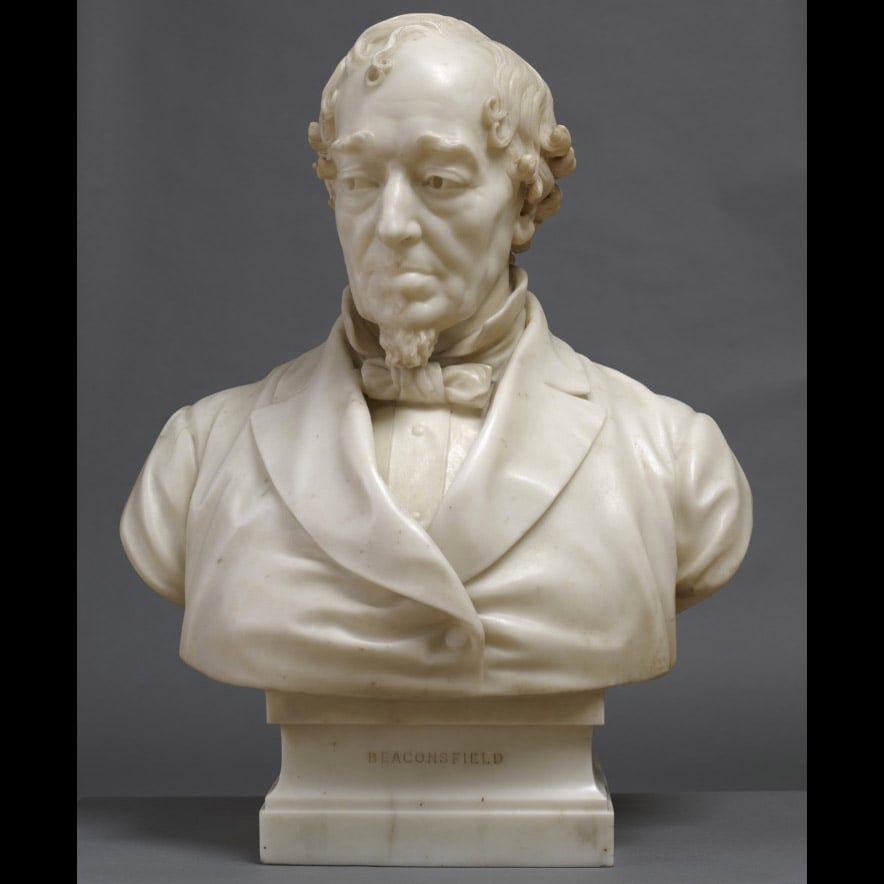
It is however a likely possibility that John Adams-Acton, Murray’s father who had died in 1910, had left the Philosopher carvings to Murray; it is entirely plausible, but conjecture, that a Royal Academician, a celebrated sculptor of marble portraits, would have had them in his studio – treasured pieces for inspiration[XII]. Murray Adams-Acton was in his twenties when his father died – if that is how they came to be in his possession, they would have been personal to him, and would explain why he never parted with them. Either way, one wonders if either John Adams-Acton or his son Murray ever knew, that the Philosopher plaques were carved c.1710, by Francesco Cabianca of Venice.
About two weeks after the report arrived, The Philosopher plaques sold to an Italian Collector.
Notes
[i] Murray Adams-Acton, ‘Domestic Architecture & Old Furniture’ G. Bless, London, 1929.
[ii] He was to publish a two part study of “The Genesis and Development of Linenfold Panelling” in Connoisseur June 1945 pp25-31 and 80-86.
[iii] See John Harris “Moving Rooms” Yale 2007 pp110-114 The Hayes Grange Room had been salvaged by Hindley & Wilkinson, and previously been offered to the V&A in 1908, before they sold it to Davis.
[iv] Harris, Ibid, p165
[v] Harris Ibid, p.174
[vi] Harris, Ibid, p.243
[vii] Harris, ibid, p240
[viii] Allom became a partner in the Camper & Nicholsons boatbuilders who designed and built the innovative “Istria”. Allom went on to form “The Gosport Aircraft Company” with Charles Nicholson developing flying boats for the Government from 1914-20.
[ix] Letter from Adams-Acton to William Wells, 10 October 1958, Burrell Collection Archive.
[x] Letter from Adams-Acton to Dr Hannah, Glasgow Museums, 28 November 1952, Burrell Collection Archive
[xi] Recorded in Acts of Scottish Parliament that were added to the statute with amendments in 2013
[XII] With John Adams-Acton bust of Disraeli, here pictured, there is a tenuous lead we might still have to follow. Disraeli was a collector of Italian sculpture and Sir Philip Rose gave him a set of relief carved portrait plaques by Orazio Marineli, a contemporary Venetian sculptor to Cabianca. (They were to be dispersed in the Christies “Disraeli Sale” of 1881 – and sold to Park Place on Remenham Hill, Henley. They were eventually bought by the Art Fund to be displayed at Disraeli’s “Hughenden Manor” where they can be seen in the Dining Room today). The Marinali plaques were released onto the market by Disraeli’s brother through Christies, just at the time that Adams-Acton (Snr) was completing his bust of the recently deceased Prime Minister – there might have been others in that collection, such as the Philosopher plaques. It’s a long shot, but research might find a link between the Marineli plaques, the Cabianca plaques, Disraeli and the Sculptor who captured his portrait - Murray Adams-Acton’s father.